Friday, March 29, 2013

Mumbai Part II

More pictures from Mumbai – come join us on a small tour.

At the Gateway of India (not to be confused with India Gate, which is in Delhi)

IMG_2867

Boats at The Gateway of India

IMG_2862

The Taj Palace Hotel - we did not stay there – it’s very fancy and expensive!

IMG_2886

Ornately inlaid flooring at the lobby of the Taj Palace Hotel

IMG_2879

Downtown South Mumbai – the car in the foreground is an Ambassador, still widely used as a cab, government and private vehicle.

IMG_2889

A beautifully decorated Parsee (Zoroastrian) residential building

IMG_2649

A young tightrope walker – she was tiny, maybe 4 years old and was already earning a living by entertaining crowds in South Mumbai, while her mom accompanied her on the drum. We didn’t finish our lunch, so we shared some chicken biryani with them, which they welcomed.

IMG_2823

The Antilia (this is actually just part of it – couldn’t get the whole building), allegedly the most expensive home in the world. It belongs to Mukesh Ambani, chairman of Reliance Industries, one of the largest Indian companies. It is 27 stories high and is maintained by a full-time staff of 600 people.

IMG_2901

Drying fish and shrimp on the beach at Juhu – the smell was overpowering.

IMG_2912

A couple of beautiful churches in Bandra, a suburb of Mumbai

IMG_2922

IMG_2934

If I were to live in Mumbai, I’d live in this building in Bandra, which is next door to Shah Rukh Khan’s house…

If I were to live in Mumbai, this is the building where I'd like to live...

… and this would be my view.

IMG_2948

Beautiful, no – I love that rocky beach. There is a Bollywood walk of fame there, where the biggest Bollywood stars have left their hand prints.

IMG_2953

IMG_2954

Next on our list was a visit to a sound studio where we saw how sound is mixed and sound effects, voices and music added to movies and commercials. We also got to play voice talents and had a chance to record our voices over some real stars’ in a TV commercial.

IMG_2975

Max didn’t care about the whole voice recording business but he loves fish and the aquarium in the studio scored major points with him. 

IMG_2966IMG_2968

Our last stop was S.J. Studios, a Bollywood studio where we saw several sets – an office, a jail, a police commissioner’s office and a hospital.

IMG_3007a

IMG_2984

We got to watch the filming of a soap opera episode in the hospital and then saw one of the stars outside, who was gracious enough to take a picture with us. We didn’t get the name of the soap opera but our guide said that the actor’s name is Arjun.

IMG_3010

Then the kids got to run around and goof off at the police station, jail and commissioner’s office:

Locked up abroad

IMG_3020

Making an entrance

IMG_3032

Daddy’s the head of the Maharashtra Police

IMG_3034

Our fun-filled adventure ended on a high note at an Asian buffet, where we ate too much and got chased by Chinese dragons.

IMG_3052

Thursday, March 28, 2013

Mumbai Part I – Dhobi Ghat

About a month ago Paul and I dragged the kids to Mumbai for a long weekend. It was on our list of places to go and Paul had to go there for work, so we went three days earlier and did the sights. It would have been lovely to stay longer, so we could do the city justice but with school and work and life in general, three days was all we had. We knew there was a lot to see and do in Mumbai and we had no prayer of figuring it all out in three days, so we hired a guide to help us see as much as possible.

Mumbai is quite a ways from Delhi, so we flew. We have flown on our last three trips in India and have had good experiences so far. The flight to Mumbai was two hours, so it wasn’t too bad. We stayed at Hotel Svenska, in Andheri, one of the suburbs, which was not ideal because it was quite far from the touristy areas but the hotel itself was nice and the service pretty decent.

Mumbai is a huge city – about 20 million - the size of Delhi or a little larger/smaller depending on who you ask and how they count. It feels big and crowded. It started out as a fishing village, which got its name from the Goddess Mumba Devi. Then the Portuguese came and called it Bombay (good bay) and eventually became a large trading port. It’s a fascinating mixture of the local Marathi plus the imported Muslim, Parsee (Zoroastrian), Christian and even Jewish cultures. It has dizzying shiny skyscrapers and crowded slums, beautiful beachside walkways and alleys you wouldn’t want to walk down because you never know what’s lurking down them, gorgeous hotels and dilapidated fishermen’s shacks. It’s a city of contrasts and surprises, which draws you in and begs to be explored.

We spent our first day mostly in Colaba (the touristy downtown area at the southernmost edge of the city) and Dhobi Ghat (a washermen’s settlement). We ate Persian food at Khyber and then relaxed at the hotel. The second day was more or less dedicated to Bollywood – we went to a couple of studios and got to see a soap opera filmed in one and played voice-over actors in the other, then checked out the beaches of Juhu and Bandra as well as the homes of some famous Bollywood stars (from outside). The more we saw, the more we liked Mumbai. By the end of our trip, we all decided that we could live there, if the opportunity presented itself.

The first place we visited was Dhobi Ghat. It’s a washermen’s community, where about 4000 – 5000 people live and work. Paul and I had seen similar communities in Delhi and kinda knew how they work. We had also seen the critically acclaimed 2011 movie Dhobi Ghat (also known as Mumbai Diaries) in which one of the main characters is a washerman and and lives/works in that community. Our guide arranged for us to go inside the community and we got a chance to talk to the washermen and hear some of their stories. They charge tourists a small fee (about $1) and use the money to provide daycare and some schooling to the kids in the community, of which there were quite a few. Chutney took a nap in his stroller while we were there, so we were able to take quite a few pictures. Here are some of them:

Bales of clothes waiting to be washed

IMG_2655

One of the “offices”

IMG_2678

Beating the dirt out of the clothes

IMG_2665

A little helper amid a pile of old sarees, which will be resold for a dollar or two or upcycled into “new” clothes.

IMG_2675

Sarees drying on a roof

IMG_2680

And a lot more waiting to be washed under the roof

IMG_2688

But it’s not just old clothes that get washed here - new shirts destined for Europe or North America are also pre-washed/pre-shrunk here…

IMG_2729


IMG_2766

… as well as new dresses you may find at the Gap or Old Navy.

IMG_2784

The new clothes are taken elsewhere to be ironed and packaged before being shipped overseas but the old clothes get ironed here using 100-year-old charcoal irons. There is electricity in the community but it’s expensive, so they use the old irons.

IMG_2795

They’ve figured out a way to hang the clothes to dry without using clothes pins – another way to save money on the whole operation.

IMG_2799

They also have a tagging system to ensure nothing gets lost.

IMG_2760

IMG_2802

This post is already getting quite long and picture heavy, so I am going to pause here but stay tuned for more pictures from Mumbai, as well as from our trip to Hyderabad and the colorful celebration of Holi in Delhi.

Monday, February 25, 2013

Two

Max turned two a couple of weeks ago but we have been running around so much that I haven’t had a chance to write about it. We celebrated it quietly at home and with a scraped nose. He took a nosedive off his tricycle the day before our improvised little birthday party, so he gets memorable second birthday pictures. 

2013-02-24

He started going to daycare on the Embassy compound a few weeks ago and seems to be liking it so much he wants to go even on the weekends. He is the only boy in a group of 5. At two he is not as well spoken as his sister was at the same age but I guess that’s a girl vs. boy thing. He is saying more and more things these days. He loves being outside and always wants one of us to “ago” (go) out with him. He would put his shoes on (and yes he still loves shoes) and pull us to the door until one of us agrees to go out with him. He says “takku” (thank you) and bye. He says and gives kisses. He says “wash” and loves washing his hands. He says “bwash” (brush) when he wants to brush his teeth. He says and does push (something he learned at school).  He knows the word “apple” but he uses it loosely - in his world, an apple is an apple, but so is an orange, a tomato and a pepper. He is very interested in our garden and goes there several times a day and points to the “pashee” (parsley), “maters” (t0mat0s), and the “nanas” (bananas). Everything that’s drinkable is juice. He does know the words for poopoo and peepee but uses them just to confuse us and get attention.

He loves, loves, loves “kais” (cars) and “pish” (fish). He just can’t get enough of them. I got a Kindle Fire for Christmas and put on it a little car puzzle game for him. Let’s just say that I have not be able to use my Kindle Fire for my own purposes much since then. He loves that puzzle game.

He loves books too. Right now his favorites seem to be “How Many Fish” and “The Little Mouse, The Red Ripe Strawberry and The Big Hungry Bear.”

He loves to run around the house and giggle with his big sister. He also loves getting tickles by Mommy or Daddy before bed.

Happy Birthday, Sweet Max!

You bring so much joy into our world – we are so thrilled to be your Mommy, Daddy and Big Sister!

Saturday, February 23, 2013

Flash Mob At Embassy New Delhi

A few days ago the Ambassador was supposed to make remarks at the Embassy about violence against women. The topic is important to the Ambassador and to all of us around the world but especially here in India and now when there’s a lot of debate in the country about women’s rights and laws to end violence against women.

A friend of ours, who works at the political section had this idea to put together a flash mob dance inspired by many others organized around the world in support of a campaign called One Billion Rising. Another colleague put together the steps and the two of them recorded a short video with instructions on when and where to gather and showing us the steps. There was a secret practice session a couple days before the Ambassador’s remarks and at the designated time, right before the Ambassador made spoke, a bunch of us, dressed in pink and red, marched in front of her and started dancing to Respect by Aretha Franklin. The Ambassador was pleasantly surprised. You can see her in the first picture behind the dancers to the left dressed in black. The Deputy Chief of Mission is dancing with us. He’s to the right in the front row in the white shirt and grey pants.

Here’s hoping that in a small way our dance and all the others performed all over the world will help elevate the cause and end violence against women.

flash mob2

flash mob

Friday, February 1, 2013

Amritsar

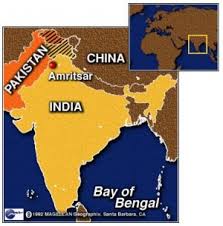
A couple of weekends ago we went to Amritsar. Amritsar is in Punjab, NW India, on the border with Pakistan. It is the heart of the Sikh religion. Sikhism is the 5th largest organized religion in the world, with approximately 30 million followers. The Sikh religion is not very well known or understood outside India because most Sikhs (about 75%) live in Punjab and 60% of the Punjabi’s are Sikh. There are a lot of Sikhs in Delhi as well and we see many of them on the visa line, so learning more about them, their culture and faith has been fascinating. Most Sikh men (but not all) never cut their hair and wear it in a turban. Some have long beards, others sort of twist their facial hair (beard and mustache together) and pull it up under their turbans. I found that strange at first because I had never seen it but am used to it now. And the turbans, with their bright colors and different ways of draping are starting to really grow on me. But I digress…

Amritsar is also the home of The Golden Temple (aka known as Harmandir Sahib), the spiritual and cultural center of the Sikh faith. We had heard so much about the Golden Temple that we couldn’t wait to see it. We were told that the best times to see it were sunrise and sunset. We went at sunset and it was amazing.

IMG_2499IMG_2507IMG_2520

The temple is in the middle of a holy pond, called Amrit Sarovar (nectar of immortality in Punjabi), which is where Amritsar gets its name. In order to get to the Golden Temple you have to go over a bridge. You also have to take your shoes off and cover your hair.

IMG_2496

It’s a truly special place and we highly recommend visiting it, if the opportunity presents itself.

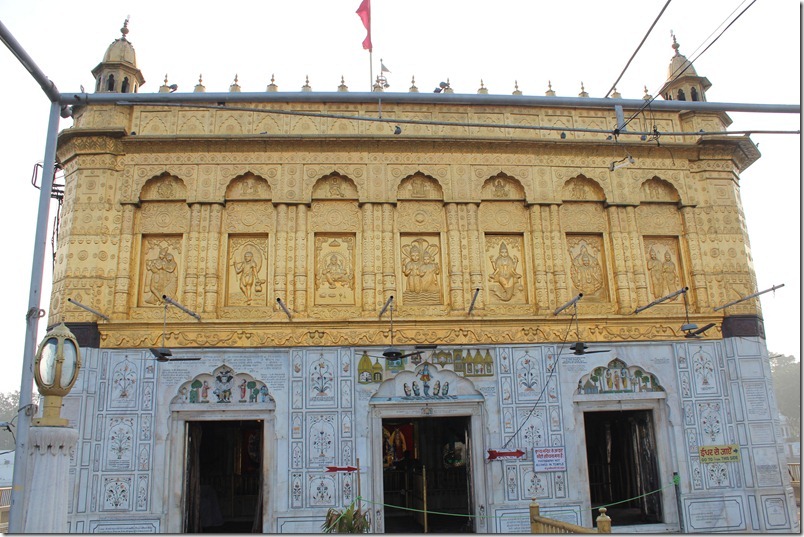
We also visited the Sri Durgiana Temple (aka Mata Sitala Mandir), which the Hindu version of the Golden Temple but on a slightly smaller scale. It’s dedicated to the Goddess Durga and is also situated in the middle of a pond. We were there at noonish and had the place almost entirely to ourselves, which was nice as we were able to talk to the priests and walk around without being surrounded by huge crowds, as was the case at the Golden Temple.

IMG_2475

IMG_2421

Another sight we visited was Ram Bagh, the summer residence of Maharaja Ranjit Singh, one of Punjab’s kings, known for his bravery. His residence is now a nice park with a museum holding multiple dioramas of battles he lead during his reign.

The last sight we saw in Amritsar was Jallianwala Bagh, a small walled-in park very close to the Golden Temple. Around 20,000 Indians were holding a peaceful demonstration against the brutality of the British rule in the park on April 13, 1919, when 150 British troops arrived and opened fire leaving 337 men, 41 boys and a baby dead and 1500 wounded in six minutes. Many found their death jumping into a well to avoid the bullets. In response, Gandhi started his famous campaign of civil disobedience, which ultimately lead to India’s independence in 1947.

A couple of other interesting observations about Amritsar: We saw hundreds of kites in the air while we were there. We were wondering if there was something special going on – a kite festival perhaps? We asked about that and were told there was nothing special, it’s just that the people of Amritsar love kites and fly them year round. Something else that we noticed was that there were a lot of women on scooters around Amritsar. This was kinda refreshing to see actually because you just don’t see it in Delhi. I had never thought about that in that sense but Delhi is not a safe place for women. I have personally never felt unsafe but I never go out alone after dark and when I am out alone I am careful about where I go. That said, Delhi has been declared the rape capital of the country, which is downright horrible and the city was shaken to the core by an incredibly brutal gang rape case about a month ago. There were huge protests that went on for weeks and a lot of discussions about laws, their enforcement and women safety. My only hope is that something good comes out of this tragedy because women deserve the right to be treated with dignity, feel save and go about their business without constantly worrying that someone might attack them.

Last but not least, we went shopping in Amritsar. A colleague of ours, who is Punjabi told us that Amritsar is famous for hand-made camel leather shoes and for patiala salwar (baggy pants). We didn’t get any baggy pants there but we did some hard-core shoe shopping. There are many shoe stores around the Golden Temple and all over town and they are so colorful and fun to explore. They look like this:

IMG_2534

I had already bought three pairs of these types of shoes before and I liked them but they are a little different than normal shoes we buy in stores in the US. When you first buy them, there’s no left or right – the two shoes are the same. After you wear them a few times the shoes conform to your feet. The camel leather is soft and they become very comfortable but they feel strange those first few times you wear them. We came home with 6 pairs, which after heavy bargaining, cost us between $4 and $6 a pair.

IMG_4032

Ours were of the less expensive variety but there were tons of different kinds with elaborate embroidery that looked really beautiful. Then there were others that were completely over the top, in my humble opinion but what do I know. I wanted to get Paul a pair with the fronts curling up but he said that was too much for him.

IMG_2533

IMG_4016

Finally, a few random pictures we took around Amritsar:

IMG_2558

Singh is indeed king in Punjab. Singh is a last name given to a baptized Sikh male and it means lion. Its equivalent for a female is Kaur, which means princess. These names reflect the egalitarian nature of the Sikh faith and were initially meant to replace a new Sikh’s original name which usually reflected his/her caste. Baptized Sikhs are supposed to wear the 5 Ks (5 articles of faith, the names of which all start with the k sound in Punjabi)  at all times– uncut hair, a small comb, a small iron bracelet, a sword/dagger, and special underwear.

IMG_2552

A man ironing clothes for people for a small fee. You see that all the time in India. They use these old coal irons. This picture also shows something else I found strange here in India at first – scarves here are not just for women, men wear them too. This man is wearing a thick winter scarf, which is almost like a blanket but men wear light scarves in the summer too.

IMG_2560

An embroidered tunic material store - also something I find interesting. In India, you can buy ready made tunics but more often people buy the material, which already has the embroidery work done. You can see the variety of necklines and designs in this store (hanging upside down). You get the material and take it to a tailor for a custom fit.

IMG_4017-001

Cargo rickshaw – I can only imagine how heavy this thing is and to think that he is moving it by his own little self seems just crazy…

Friday, December 28, 2012

The Taj Mahal

So we did go to the Taj on Christmas Day. Getting there and back was a royal pain and it took forever, so we didn’t get to see anything else but I don’t want to write about that. I want to write about the the Taj because being there was amazing. I guess it’s one of those things that you just have to see to appreciate. It is bigger and more magnificent than what I thought it would be based on pictures I had seen. And there are some terrific pictures of it out there. We took a bunch too and I thought I’d share them with you here, so let’s take a “tour,” shall we?

First, here is a nice map of the whole complex to help you follow along, courtesy of the Smithsonian Magazine:

047__002V0

We entered the complex through the East Gate (2 above, left below), went through the forecourt (4 above) and found ourselves in front of the Great Gate (7 above, right below), which is made of marble and red sandstone, decorated with semi-precious stone inlays and calligraphy.

IMG_4010IMG_2254

Even though it’s called a “gate,” inside the Great Gate is a room which is kinda dark and as you enter it, you immediately see the Taj beautifully framed by the Mughal style arch.

IMG_2267

Then you step out and get a full view of the Taj and the Mughal gardens around it. The gardens are said to represent heaven on earth. The view is truly breathtaking, or at least it was for me. I remember thinking, “Wow, he must have really loved her!” because it was commissioned by Mughal Emperor Shah Jahan in memory of his favorite wife, who died delivering their 14th child. Of course, he was the head of a very large empire and he could afford to do something like that but the point is, he didn’t have to. She was already gone. He chose to do it and that’s beautiful. Because the Taj is a true masterpiece, evidenced by the millions who make the trip to see it. We went on Christmas Day thinking there would be less people because Christians are a minority in India but it was packed. Go figure…

IMG_2274

On each side the Taj is flanked by two matching buildings (pictured below, and 13 and 14 on the map up top)  constructed in the same style/materials as the Great Gate – one is a mosque and the other was a guest house.

IMG_2349IMG_3973

The Taj itself is made of white marble and is also decorated with semi-precious stone inlays and calligraphy.  It is surrounded by 4 tall marble minarets. Here are some close ups:

IMG_2383a

IMG_3985 IMG_2379

It backs onto the Yamuna river, the largest tributary to the Ganges.

IMG_2371IMG_2370

We did not go inside the Taj because the lines were very long. See those people on the balcony and below it - they are all waiting to get in.

IMG_4001

We did get some nice people to take a picture of all of us in front of the Taj though.

IMG_2307

So there you have it, a tour of the one and only Taj Mahal. Hope you liked it.

 
Locations of visitors to this page